Samsung Unveils 300 Hz OLED Display Panel for Next-Gen Gaming Laptops
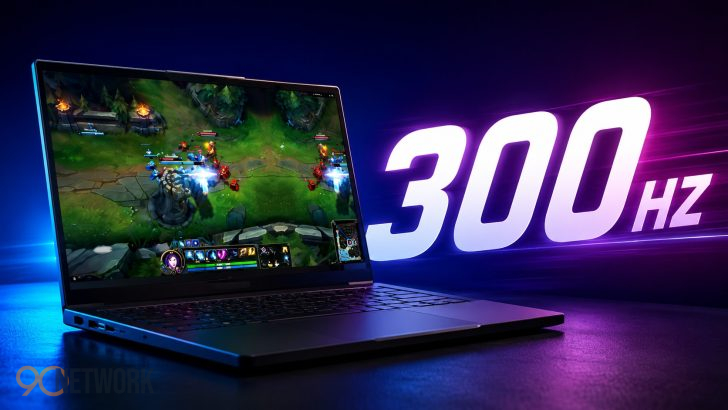
Samsung Display has showcased its latest panel innovation aimed at high-performance portables, unveiling a Samsung 300 Hz OLED display built specifically for gaming laptops. The new panel combines an exceptionally fast 300 Hz refresh rate with a crisp 2.5K resolution, setting a higher benchmark for visual speed and clarity on mobile devices.
The company demonstrated the prototype hardware at the IMID 2026 display conference in Busan, South Korea. While OLED screens have gradually gained market share across premium laptop models, high-refresh enthusiast gaming laptops traditionally relied on high-speed IPS or TN panels. This new development highlights Samsung Display’s ongoing push to bring high-end OLED panel options into mainstream and enthusiast mobile gaming segments.
Key Details of the Samsung 300 Hz OLED Display
High-refresh laptop screens traditionally require players to choose between resolution, color quality, and raw motion smoothness. The Samsung 300 Hz OLED display aims to eliminate these compromises by combining sharp visual fidelity with ultra-fast frame delivery.
| Specification | Details |
|---|---|
| Panel Type | OLED |
| Resolution | 2.5K |
| Refresh Rate | 300 Hz |
| Target Market | Enthusiast & Gaming Laptops |
By offering a 2.5K resolution at 300 Hz, the panel delivers both fine graphic detail and extremely fluid animation. Fast motion handling is particularly vital for competitive players who rely on instantaneous visual cues during fast-paced gameplay.
Why Higher Refresh Rates Matter on OLED Laptops
OLED technology offers unique advantages over traditional LCD structures. Because each pixel emits its own light, OLED screens achieve self-lit pixels, infinite contrast ratios, deep true blacks, and virtually instantaneous pixel response times. When paired with a 300 Hz refresh rate, image motion clarity improves drastically compared to standard 60 Hz or 120 Hz screens.
On standard LCD displays, pixel transition times can sometimes cause motion blur or ghosting, even at high refresh rates. The inherent pixel response speed of an OLED matrix minimizes motion artifacts. As a result, the Samsung 300 Hz OLED display should deliver cleaner, sharper moving images during rapid camera pans and intense action sequences.
Broadening the Premium Laptop Display Ecosystem
Over the past few years, laptop makers have increasingly adopted OLED panels for creative applications, productivity notebooks, and mid-tier portable devices. However, competitive gaming laptops required faster refresh rates than earlier laptop-sized OLED panels could provide.
This demonstration demonstrates how rapidly display manufacturing is adapting to enthusiast gaming demands. By expanding production capabilities and driving technical advancements, display manufacturers are preparing the ground for upcoming laptop lineups. Gamers looking for high-end portables will soon have access to panels that deliver top-tier picture quality alongside competitive frame rates.
Continue with more high-refresh rate gaming laptops from our technology desk.