Tesla FSD Probe Enters a More Serious Phase as U.S. Regulators Tighten Scrutiny
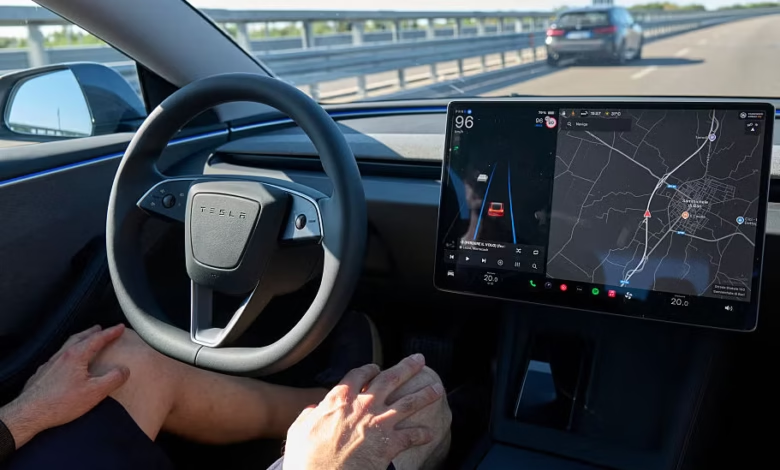
Federal safety regulators in the United States have stepped up their review of Tesla’s driver-assistance technology, adding new pressure at a sensitive moment for the automaker’s self-driving ambitions. The National Highway Traffic Safety Administration has moved its investigation into Tesla’s Full Self-Driving (Supervised) system into an engineering analysis, a more advanced stage that often comes before recall decisions or other enforcement action.
The sharper federal focus centers on how Tesla’s software performs when visibility is compromised. Investigators are examining whether the system can properly recognize hazardous conditions such as glare, fog, or airborne dust, and whether it gives drivers enough warning when cameras may no longer be interpreting the road reliably. According to the agency’s findings described in coverage of the move, several crashes in reduced-visibility environments raised concern that the software may not have responded adequately.
This development matters well beyond one automaker. It touches on a larger debate that has followed advanced driver-assistance systems for years: how these tools are marketed, how drivers understand their limits, and how regulators should intervene when software behaves unpredictably in real-world situations.
Why the Investigation Just Intensified
An engineering analysis is not a routine administrative step. It represents a deeper and more technically detailed phase of a federal defect investigation. NHTSA’s Office of Defects Investigation first opened this review in October 2024 after reports of four crashes involving Tesla vehicles using Full Self-Driving in low-visibility conditions. One of those incidents was linked to the death of a pedestrian.
Since then, regulators and Tesla have reportedly spent many months exchanging information. During that process, investigators appear to have identified additional cases involving similar environmental conditions. The agency also said it still lacks some of the information it has requested from Tesla, including details tied to a software fix Tesla began developing in mid-2024 to address low-visibility problems. Regulators said they have not been clearly told whether that update was widely deployed or which vehicles received it.
That uncertainty seems to be a major reason this case is gaining momentum. When regulators believe there may be a defect affecting a large number of vehicles, and when the paper trail around corrective actions remains incomplete, the situation tends to become more serious quickly.
What Investigators Are Looking At
The probe is centered on a critical safety question: can Tesla’s system recognize when its own perception is degraded?
Tesla’s Full Self-Driving (Supervised) technology relies heavily on camera-based sensing. In theory, the software should detect when visibility is impaired and alert the driver that system performance may be reduced. But regulators said crash reviews showed situations where the software either failed to identify that degradation soon enough or did not give drivers sufficient time to respond. In several reviewed cases, the system also reportedly lost track of, or never identified, a vehicle ahead in its path.
That issue goes to the heart of how assisted-driving systems are expected to work. Even when these features are not marketed as fully autonomous, they must still behave predictably and provide clear signals when human intervention is necessary.
Key areas under the microscope likely include:
- How Tesla detects reduced camera visibility
- How quickly the system warns the driver
- Whether those warnings are clear and actionable
- Whether the software can continue safe operation in degraded conditions
- How Tesla documented, tested, and rolled out any fixes
These are not minor technical details. They shape the difference between a driver getting an early warning and a driver receiving an alert when it is already too late.
The Scale of the Safety Question
Reports on the expanded review indicate the probe now covers millions of Tesla vehicles equipped with the software, making it one of the most consequential active safety investigations tied to advanced driving technology in the U.S. Reuters reported the engineering analysis now includes roughly 3.2 million Tesla vehicles. Earlier reporting in 2024 had put the original population under review at about 2.4 million vehicles, suggesting the scope has grown as the agency’s work progressed.
That broad reach raises the stakes for both Tesla and regulators.
For Tesla, the issue is not just about software performance in edge cases. It directly affects public confidence in one of the company’s most heavily promoted technologies. For regulators, the case could help define how aggressively the government oversees increasingly sophisticated driver-assistance tools that operate somewhere between conventional cruise control and fully autonomous driving.
A Bad Time for Tesla’s Autonomy Push
The intensified investigation comes at an especially delicate point in Tesla’s strategy. The company has been trying to push further into autonomous mobility services, including robotaxi ambitions in Austin, Texas. At the same time, federal officials have already been seeking answers from Tesla about how its systems would handle low-visibility and adverse conditions in those deployments.
That timing matters.
When a company is asking the market, regulators, and the public to trust more automation, any active defect probe involving perception failures becomes much harder to dismiss as a narrow technical dispute. A system that struggles in glare, fog, or dust under supervised use will naturally face harder questions when used in broader autonomous operations.
In practical terms, the investigation could influence:
- Launch timelines for autonomy-focused services
- Regulatory confidence in future deployments
- Legal and compliance costs
- Public perception of Tesla’s self-driving claims
- Potential recall obligations or software mandates
Even if Tesla avoids a formal recall, the reputational impact of a prolonged federal review can be significant.
The Broader Industry Problem
Tesla is the highest-profile target in this case, but the broader issue affects the entire automotive industry. Advanced driver-assistance systems are improving rapidly, yet real roads remain messy, inconsistent, and full of sensory challenges. Sun glare can blind cameras. Dust can obscure lane markings. Fog can compress visibility and distort perception. A system that performs impressively in clear daylight may behave very differently in degraded conditions.
That is why regulators increasingly focus not only on what a system can do when everything works perfectly, but on how it behaves when sensors become unreliable.
For automakers, that means the bar is rising. It is no longer enough to demonstrate feature capability in favorable conditions. Companies must show that their systems can fail gracefully, alert the driver appropriately, and avoid creating a false sense of security.
Tesla’s case is likely to be watched closely because it may shape how future investigations are handled across the sector.
What Could Happen Next
An engineering analysis does not guarantee a recall, but it does move the process much closer to a decision point. This stage typically involves deeper technical evaluation, a more exhaustive review of incidents, and closer examination of internal company responses. If regulators conclude a safety defect exists, they could push for a recall or other corrective action.
Possible outcomes include:
- A formal recall tied to software behavior
- Expanded software updates with stricter safeguards
- Additional reporting requirements for Tesla
- Continued monitoring without immediate enforcement
- Further public documentation from regulators about system limitations
Much may depend on what Tesla provides next and whether investigators conclude that any prior software changes truly addressed the core problem.
Why This Story Matters to Drivers
For Tesla owners, the biggest takeaway is simple: driver-assistance software still has limits, and those limits can become more pronounced in poor visibility.
Even when a system is marketed as highly capable, it does not remove the need for active human supervision. Federal investigators appear concerned that, in certain real-world cases, the software may not have recognized its own limitations fast enough. That is exactly the kind of gap that turns a convenience feature into a safety risk.
For the wider public, this case is another reminder that the path to vehicle automation is not just about innovation. It is also about accountability, transparency, and how quickly companies respond when safety questions emerge.
The Bottom Line
The Tesla FSD probe has moved into a far more consequential chapter. Regulators are no longer just collecting preliminary information. They are examining whether the company’s software can safely manage one of the hardest real-world challenges for camera-based driving assistance: knowing when visibility has become too poor to trust the system.
With millions of vehicles potentially affected and Tesla pressing ahead with larger autonomy goals, the outcome of this case could carry weight far beyond one investigation. It may influence recalls, software standards, regulatory expectations, and the public’s tolerance for bold self-driving promises that collide with imperfect road conditions.
In the months ahead, this will be one of the most important automotive safety stories to watch.